

You Would Have Won. But You Didn't.
What three profitable NFL seasons actually look like, and why most people cannot survive the ride.
The Myth of the Smooth Line
Somewhere in your head, there is a picture of what a winning bettor's season looks like. He is sitting in a Lambo, Rolex on the wrist, and most importantly, he is watching a line go up and to the right. Maybe a small dip here and there, but mostly up. Steady. Predictable. Proof that the model works. You are printing money at all times, because you know what will happen.
That picture is wrong.
Three seasons. 129-100. 56.3% win rate. 7.1% ROI. Profitable every single year. Here is what it actually looked like:
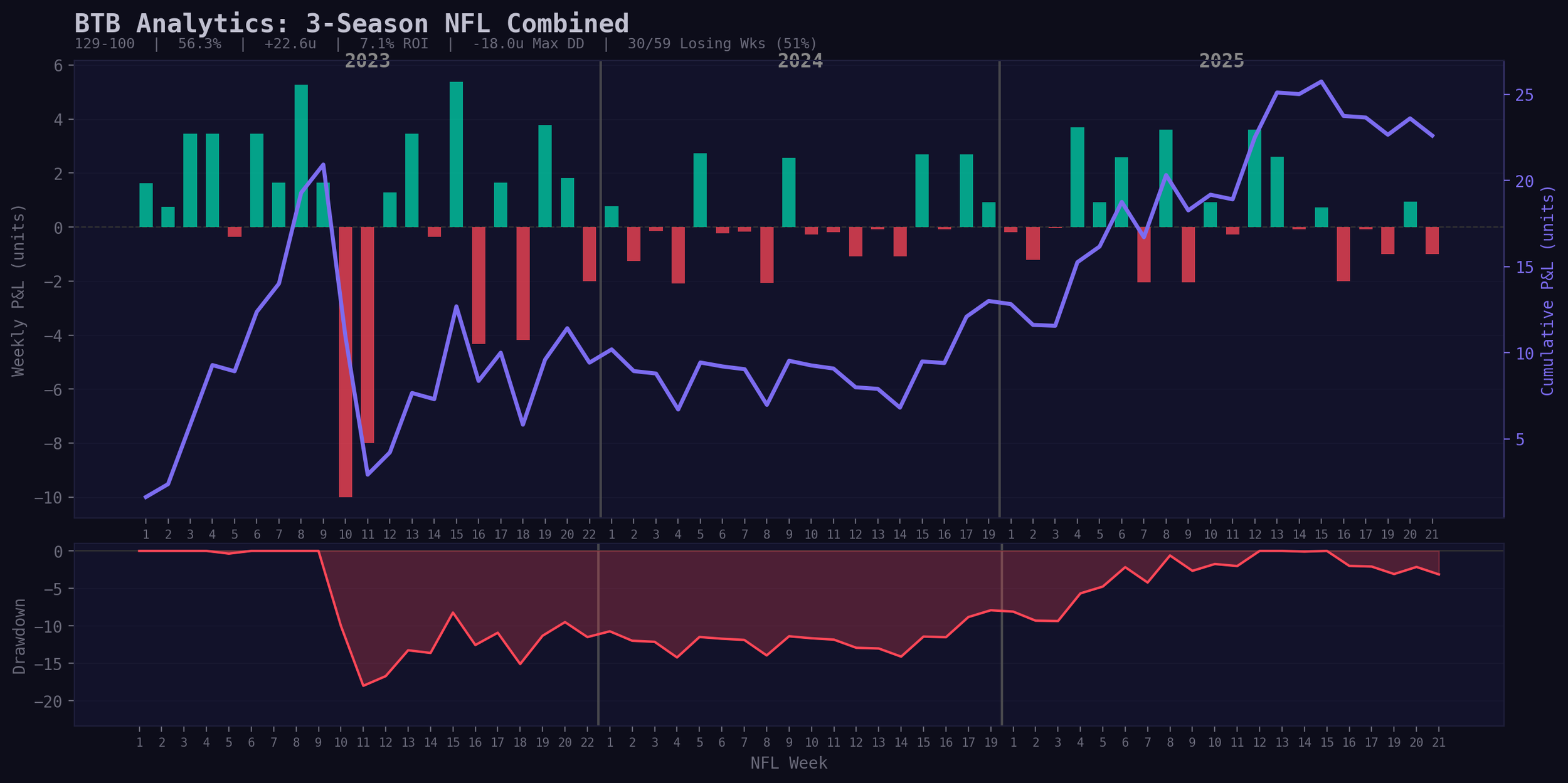
7.1% ROI. Over half of all weeks were losing weeks. The purple line still goes up.
Count the red bars. There are more of them than the green ones. Over half of all weeks across three NFL seasons were net negative. Yes, you read that right: most weeks were negative weeks. The purple cumulative line still goes up, but it does not go up in a straight line. It grinds. It chops. It drops. It recovers. It drops again. It can be painful. It is scary. And that is even when these are "drawdown from peak" and you are giving back profits you already made, not losing your starting bankroll.
This is not a defect. This is the math of what actually winning looks like.
Three Seasons, Three Different Stories
Here is what makes this even harder to sit through: each season looks different. There is no pattern you can learn and expect. The variance expresses itself differently every year.
2023: Won Everything Early, Then Survived
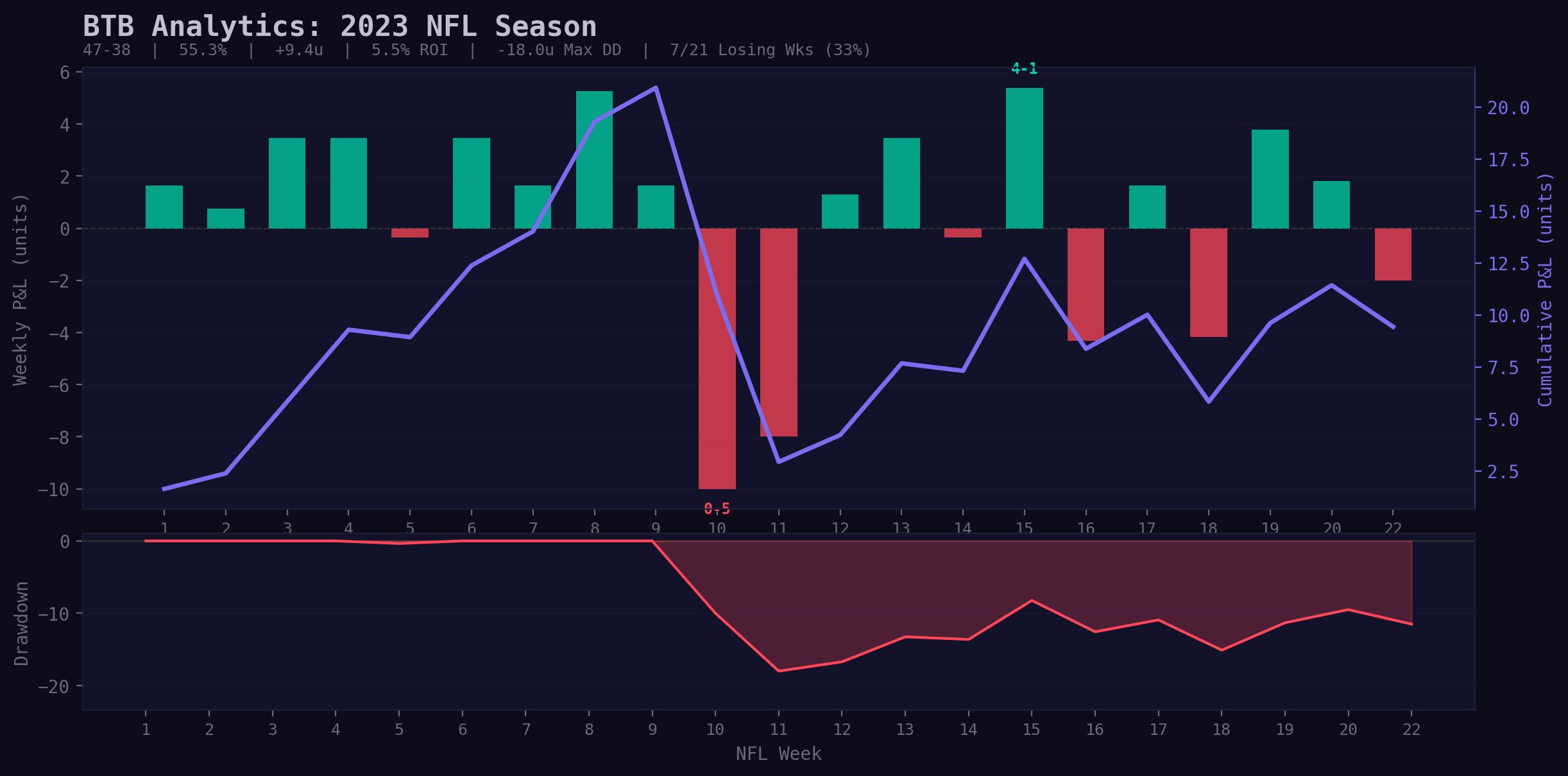
2023 NFL: 47-38-1. 55.3%. 5.5% ROI. 7 out of 21 weeks were red.
The 2023 season was front-loaded. Weeks 1 through 9, the model ripped. The cumulative line climbed to +10.5 units. If you started following BTB that year, you thought you had found a cheat code. And you did, but it is not the cheat code you think, meaning winning forever, non-stop.
Then Week 10: 0-5. Week 11: 0-4. Nine consecutive NFL losses. The cumulative line fell off a cliff. And this is where you say, "I knew these guys were full of shit."
2024: A Slow Grind to Nowhere (Until It Wasn't)
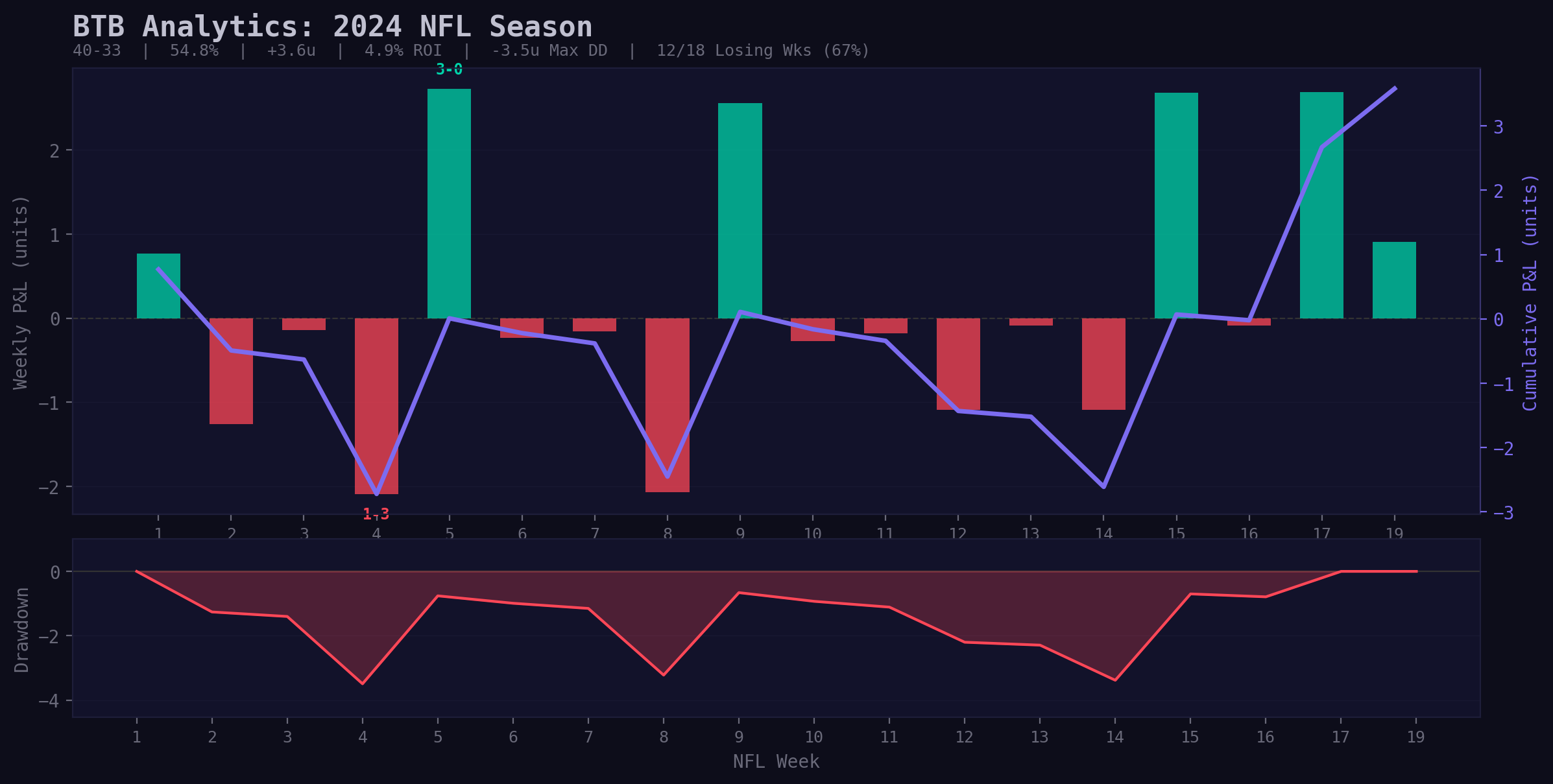
2024 NFL: 40-33. 54.8%. +3.6 units. 4.9% ROI. 12 out of 18 weeks were red.
The 2024 season is the opposite story, and honestly the harder one.
67% of weeks were losers. Twelve out of eighteen weeks finished in the red. The bankroll went negative in Week 2 and stayed underwater for most of the season. This was not a drawdown from profit like 2023. This was actual red on the account. Week after week of small losses: -0.2 here, -0.1 there, -1.1, -0.09. A slow drip that felt like nothing was working. How and why do you keep betting? How do you know you have an edge? (CLV!)
Then Week 15: +2.7. Week 17: +2.7. Week 19: +0.9. Three green weeks at the end of the season pulled the entire thing positive.
2025: The Best Season Still Hurts
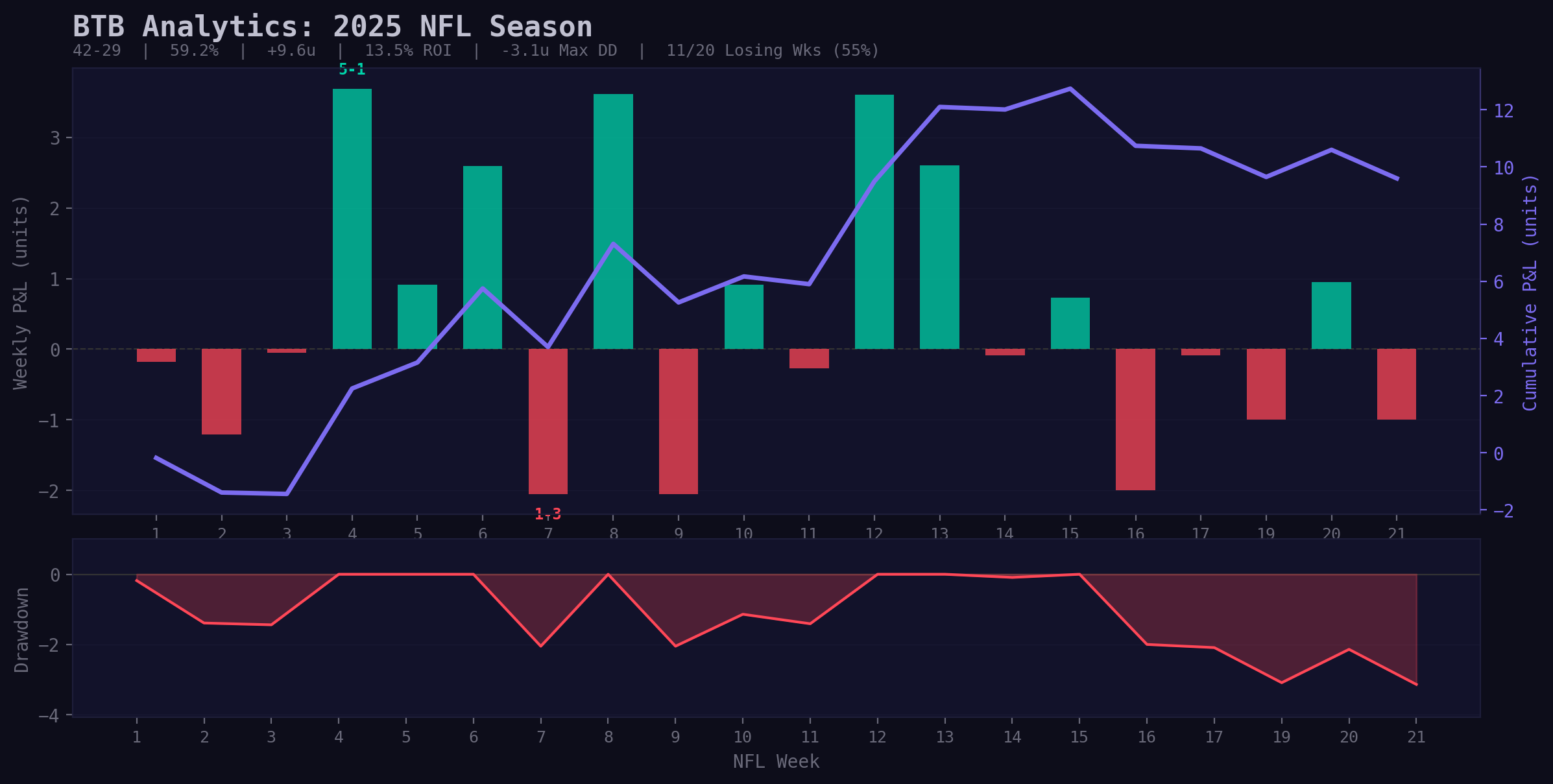
2025 NFL: 42-29. 59.2%. +9.6 units. 13.5% ROI. 11 out of 20 weeks were red.
The 2025 season was our strongest in terms of ROI. 42-29. 59.2%. 13.5% ROI. And still, 55% of weeks were red. We went 1-3 twice. We went 0-2 in Week 16.
Loss Aversion
This is the real reason winning is so hard. Across the three pathways we highlighted above, and everything else we have shared with you, there is one critical thing no one talks about: winning involves a lot of losing. 2025, a 59% win rate, which is elite and hard to do. That is great. But it also means we lost 41% of our bets. That is still a lot of losing.
And guess what: we are all hard-wired for loss aversion. That is a fancy way of saying we feel more pain when we lose than we feel pleasure when we win. And it is not even close. This is why when you win 3 units in a weekend, you feel good. Like you have a crystal ball. But when you lose 2 units, you might fist fight your mom. Ultimately, it makes an edge hard to endure, week in and week out. You lose faith. You fight placing that next bet because you do not want to lose.
This is natural. But it is also the reason it is even harder to win, (yes, even when you have an edge). I would go as far as to say it is actually harder to win when you have an edge, because you have to hold a realistic expectation of winning: I expect to win 55 out of 100 bets, and I expect to lose 45 out of 100 bets. When you live in utopia tout land, you are expecting that 4-0 sweep because they are so confident. You sign up with hope and faith. You get to suspend reality. But in the real world, if you have an edge, you are going to do a lot of losing on your way to profit.
I struggle with this every day, every week, every season. The drawdowns are real. They are painful. But they are part of the reality of dealing with an edge. By definition, we cannot and will not win every bet. You will lose. And there is no statistical law that says your edge will pay you equally each week until the season is over. As you have seen, and maybe lived through with us, it can and does look different every week. There are swings. For us, and against us. But at the end of the season, we end up where we expect to be.
Loss aversion is tough. It is real. It is human. But if you do not know that it is there, it can and does affect how well you can implement a sharp strategy or bet a model that gives you a real edge.
This is where the critical signal we went over in Part 1, CLV, becomes even more important. Good week? Does not matter, did I get CLV? Bad week? Does not matter, did I get CLV? If the answer most weeks is yes, I got CLV, then the outcomes will catch up at some point. This is how you survive drawdowns and the pull of loss aversion. I use it as my north star to keep my head on straight and my emotions under control, and it lets me step up to the plate week after week, regardless of whether I had a good week, a bad week, or a big week.
If an edge is real, the CLV confirms it. The returns will prove it. But the edge only works if you let it work. And letting it work means sitting through weeks and months of red bars, trusting the process when the results say otherwise, and understanding that the turbulence is not a flaw. It is the price of admission.
Charts reflect NFL spread bets only at 1 unit per play, standard -110 juice assumed.