

2026 NFL Futures Deep Dive Part 1
How we find value for NFL Win Totals and Other Futures
We are trying something new this year and sharing our thoughts and methods for how we derive these bets. This should help you navigate all the output, use it to your advantage, and peel back the curtain on how we think about some of these things. If you do not care about this, skip to the output and the betting guide. If it matters to you, keep reading.
Futures, along with all of these markets, has been a very interesting lean for me, and frankly a big part of my learning and evolution. My background in health economics has, as you can imagine, made me approach problems the way I see them in that context. That is what I know how to do. Said more simply, for futures I was bad at pricing these (maybe I still am). That is because for a long time I priced these markets on flags tied to the characteristics of a team, things like a new QB, or a new OC, DC, or HC, or any combination. Those felt important, and they can be, but they are not the same as a raw simulation of the season built on a power rating of the teams. After a few years of getting lucky, I started to explore simulations and the power they have, and, like you will see a lot from me, blending things together to get an even better answer. So that is where I am today. The main driver of all of these numbers comes down to the simulation of the season first, then some qualitative checking, the art of sports forecasting.
At its core, any edge, and I will call this alpha a lot in these writeups, comes from QB play. When I started this journey almost five years ago, I stumbled onto some interesting findings on how pricing QBs can have a major impact on the results of games, and, no surprise, on your edge in the market and, most important, your ROI.
So that is where I start, a power rating of the teams based on how they performed last year, a lot of play by play, and most important an adjustment for who the QB is. See the list below.
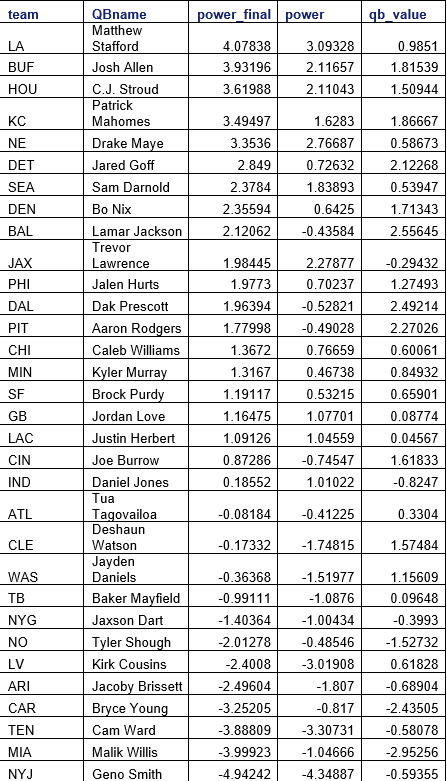
This power rating is critical for the simulation. It is a way to say a team is x points better than another, and it lets us use a Monte Carlo method to produce probabilities and win totals that turn out to be quite accurate. But this is where I really try not to work in a silo of whatever other helpful information is out there for us to use. I bolded helpful because it is harder to find than you think. Most analytical or opinion based stuff on the internet is trash and should be ignored. It is a guy with no understanding of real statistical methods holding up a finger and saying, with a high level of conviction, THE RAMS ARE UNSTOPPABLE. See the writeup about price. Remember, price dictates edge, so it is all about getting the most accurate representation of what we know analytically today, so that when we shop our number against the market, we can win.
So the next step is to find those other systems and methods and fold them into our numbers. Here is what that looks like, for transparency.
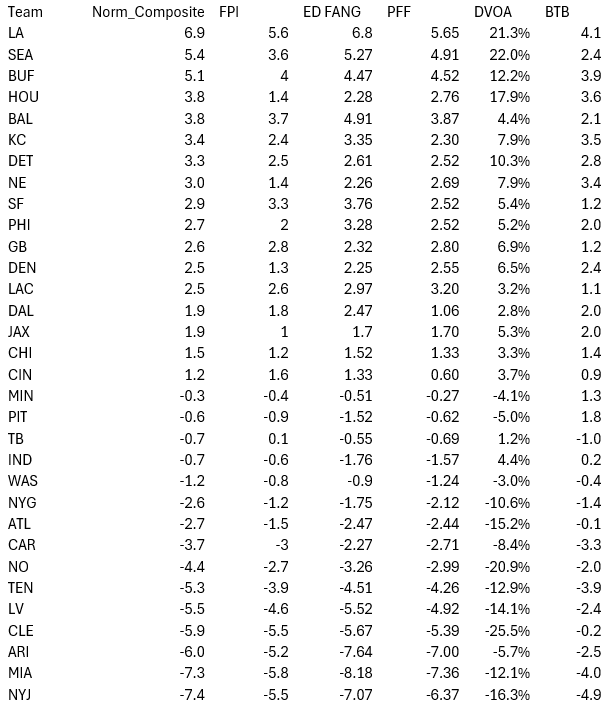
As you can see, we use DVOA, PFF, ED FANG, and FPI to see how they are rating these teams. We do some fancy math called normalization so that we can add them all up, and out comes a very robust power rating. From here you can do one of two things. You can run simulations on this new blended power rating, or you can run a separate simulation off each individual power rating, normalize those results, and blend the outputs. For the purposes of this writeup, we go with the blended approach.
This method gives you a very good idea of overall outcomes, say win totals. It takes into account the things you know your own numbers already capture, for us that is QBs, but it also lets you fold in the blind spots your method may leave out, like an adjustment for defensive opponent the way DVOA does. It gives you a really robust, independently derived number. Once we have these numbers, we shop them against the market and see what candidates we have. Remember, this is where things may look different than you expect, because now we are shopping our prices against the market. I am not focused on narratives, GOAT talk, or the fact that in the last 20 years x, y, z has never happened. Maybe with the exception of the Jets winning, that one might be real, science and statistics be damned. But you get the point. We do not want to shop these prices with narratives in mind. It is all about edge. And one last piece, which we touched on at the beginning. Do the work of figuring out what you think the price is, then go find other people who are doing this work too. When you find an edge, see if those other smart people agree. There is a lot of power in that, especially when you are forecasting things like win totals, where the distribution of outcomes is wide. You will hear this called variance. It is just a way of saying no one is very certain about the output, there is a wide range of what will likely happen around the middle. So here is how we ended up at our season win total bets, step by step.
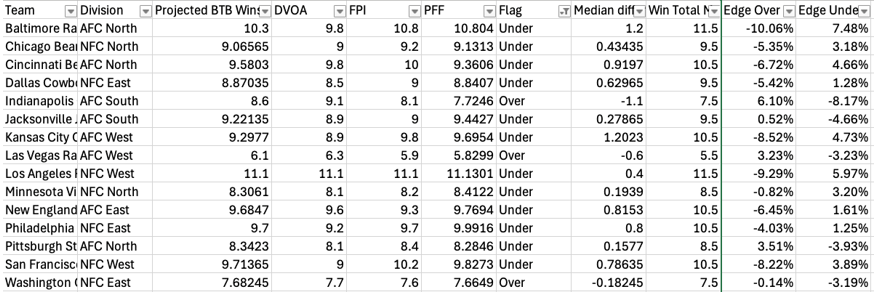
First, right off the bat, we rule out 17 bets because the different power ratings and simulations do not agree on direction. Say three of the four models want the over but one wants the under. Why chase those when we have 15 bets where they all agree. Next we compare our median win projection to the market, how many wins apart we are. Price matters, but when you sort by the median difference in wins, you will see the biggest edges line up with the biggest gaps.

Filtering to games where we have at least a half game edge, over or under, gives an even smaller list, seven games we have an edge on. But PHI and NE are both only 1 to 2 percent, not worth locking money up all season, so they drop.

That leaves these five bets, two overs and three unders. Take LV as an over. Could this team be good? Yes, they could. New coaching, a veteran at QB. But on the other side, do we feel confident that Kirk Cousins is the QB all season for them? I do not, mostly because if they are not good, they have every incentive to see what their first round pick can do. Because I feel the QB certainty for the full season is lower here (yes, feel, I cannot prove it), and that sits on top of normal injury risk (and Cousins is already injury prone), that is one more reason to pass on this bet.

And there you have it, four bets, three gross unders and a meh over. Almost every year I end up in this spot, and these bets never look good. And yet we are right more often than not. Why? It is all about price.
OK, on to the fun part. There is more data around these bets and deeper dives on where I think the value is coming from for the four of them, plus some other season long analysis. The deep dive on the four win total bets is the Win Totals writeup, that is where I break each one down. The futures, division, conference, and Super Bowl, are their own card, the Futures Deep Dive. Same engine, just the season long and futures sides of the board.
If you like this kind of content, be sure to subscribe to get alerts whenever a new article drops. We take this same analytical approach to our weekly bets for NFL and College Football. Get access to all our predictions today!